by Meghan Loveless and Rebecca Werthmann
I (Meghan) remember a car ride home from the CCFLT conference in February of 2020 in which I was desperately trying to convince my then co-worker Rebecca to join me in some lesson-plan-switching chaos. I wanted Rebecca to ditch her plans and join me in trying out one of the March Madness music competitions! I had already participated once on my own. Having been through it once, I was excited at the thought of having someone to share the work load of planning and creating materials.
What is March Madness?
March Music Madness is a bracket-style music competition with complex origins–with Jeff Klempka, Nathan Black, Dustin Williamson, and Justin Buehler all seeming to have a hand in its early development. In the same way that college basketball’s March Madness is a bracket-style tournament that ends with one team crowned champion, March Music Madness involves songs competing against each other for students’ votes until one song is chosen as the favorite.
In recent years, a number of teachers and creators have begun creating and releasing brackets each March. Some of the brackets are set up for teachers to run on their own with just their classes, and some of the competitions now have complex voting systems so that classes around the world can vote in the same tournament. There are quite a few popular Spanish brackets, and French teachers join in Manie Musicale!
Why March Madness?
Back to that car ride in 2020… Rebecca was hesitant (she is type A and I am more type B), so I had to do a lot of convincing on why this was well worth our efforts. If I recall correctly, it went something like this:
- It’ll be fun
- We get to listen to music
- Girl, it’ll be so easy (my FAMOUS last words)
- It’ll be fun
- We can watch music videos
- It’ll be fun
- There is so much culture
- It’ll be fun
If I’m honest, in 2020 I may have been doing it ALL wrong! Now with some more knowledge and experience I’d convince her in a whole different way! I’d tell her:
- It builds connections
- It is authentic
- It builds connections
- It helps explore culture
- It builds connections
- It’ll be easy (HA!)
- It builds connections
Rebecca eventually said YES, and we made a great team! We had such a great experience that both of us have continued planning March Madness into our course maps. Now, with a few years’ knowledge and competitions under our belt, we have honed the process and love what we do!
How Meghan does March Madness now
I (Meghan) teach middle school Spanish 1, Spanish 2 & 3 (combined) and this is how I use a music competition to connect with my students!
First: Vibe check!
Before the competition, the first step is to listen to all of the songs. The goal here is to get a good feel of them and rate them on the rating sheet. This usually takes an entire day of listening. Students use the rating sheet to give each song stars. Students decide on their own what criteria they are going to award stars. The vibe of the song is also in question and students make their own decisions based on their preference!
Second: Who will win?
After students have had an opportunity to check the vibe of each song (and still before the competition begins), I clear off one of my white boards and create a BIG bracket where we follow the songs that make it through each round. The bracket has the starting matchups of the songs on the left and right sides, but the middle of the bracket is empty so that it can be filled in as the competition advances.
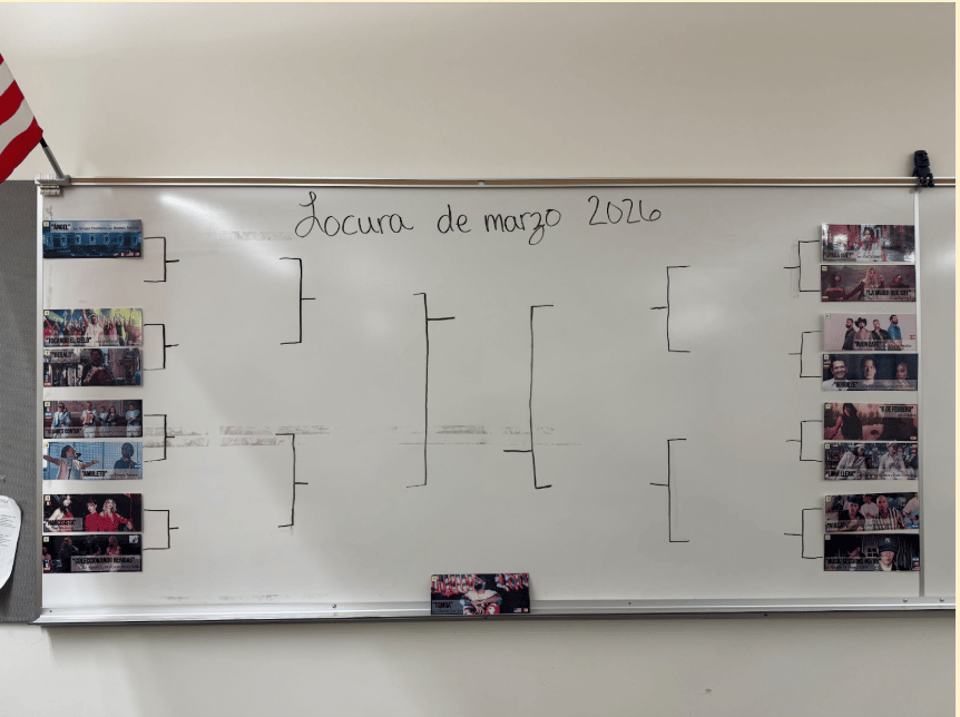
With my bracket posted, students view the matchups and fill in their individual bracket. I have them fill out a bracket showing their personal preferences of each match-up, leading up to the song that they hope will win. Alternatively, you could have them fill out the bracket based on which songs they THINK will advance; even if it wouldn’t be their personal preference. Students guess which song will advance from each match up until there is only one remaining song!
After they have filled out their own brackets, I have every student write their name on the big bracket (on my whiteboard) under the song that they hope or anticipate will win. At the end of the competition, any students who guessed correcty from Day 1 wins a small prize.
Once this is posted, we talk about it! This communicative activity is all about making predictions and finding agreements (and disagreements!). After all, nothing builds community like a good disagreement, amiright?
The conversation can begin as simply as me making an observation, in the target language, with a statement like, “Oh, Maddy thinks Álvaro Soler will win the competition, who else thinks that?” and then, “Oh, Isaac does not think Álvaro Soler will win; he thinks that Aitana will win the competition. Oh no!”
Third: Who is who?
Next, we spend some time getting to know the artists. In the past I have used an Artist Scavenger Hunt that another teacher has created for the Madness competition. Students read biographies of the artists in the competition and the Scavenger Hunt questions and identify which artist matches which question.
As you can imagine, creating something like this on your own (biographies of every artist plus a scavenger hunt activity) would be an extraordinary amount of work. This is one of the benefits to either participating in one of the big, public competitions or purchasing a pre-made bracket from a creator who includes this element with their bracket! The biographies should be easy for your students to understand so that they can connect with the information and acquire language through reading. Generally speaking, it is rather easy to adjust the text complexity of a biography simply by increasing or decreasing the amount of information you share–so do it!
Why I love reading artist biographies
The artist scavenger hunt is an easy way to help students understand just how popular and significant these artists are. Students who speak English as their first language are often totally unaware of global superstars who primarily sing in languages other than English, even if they are bigger stars than the ones students do know and love. For your students who already know and love these artists, it’s a great opportunity to let them shine as someone who’s already “in the know” about these big names!
Fourth: Rounds and Match-ups
The competition begins with the first match-up! In the competition I have participated in, one new match-up is presented each day. Since my school operates on a 4-day school week, we sometimes need to do two match-ups in a single day to make sure that my students get the chance to vote while the voting window is open.
With each new match up, I look for something about each song that we can communicate about. Sometimes this looks like investigating geography; for example, we might do a Map Talk about the country or region the artist is from or about a place mentioned in the song or shown in the music video. Other times this means taking a deeper look at a cultural aspect that is featured in the song lyrics or music video. Still other times we might focus more on the emotions of the song or the actual message being communicated through the song lyrics. Occasionally we use ClipChat to talk about the music video, especially when it tells a story or is set in a target culture location. What connections we dive into totally depends on the song!
In addition to creating connections, I generally
- discuss the voting (which is a great opportunity to use large numbers in context: how many votes did each song get, percentages, who got more/fewer votes, how many did they win by, etc.)
- review information about the artist from their biography or current events
- teach the chorus of the song (display lyrics, help students understand them)
- establish gestures for keywords or repeated vocabulary
With all of this song-based communication, March Madness really becomes my core curriculum for the month. We more or less take a break from Vamos and Somos, because we don’t have a lot of extra class time once we’re finished digging into the match-up for each day! I’ve found that this is not a problem in terms of continuity for the curriculum; we can pick up where we left off when the competition is over without losing any ground. And, the break from routine comes at a great time in the school year!
How Rebecca does March Madness now
I (Rebecca) teach high school Spanish 1-4 to a variety of students ranging from novice-low to Heritage learners. Participating in March Madness is definitely one of the top things that keep my students re-enrolling in my classes, and they’re already asking me on the first day of school if I know anything about that year’s upcoming competition!
My main goal (and justification for March Madness taking up such a large chunk of days), is to keep everything comprehensible and stay in the TL as much as possible. For every activity I plan, I keep this goal in mind. I want to have fun and keep students interested, but acquisition is always my number one goal!
Step One: Prep Time
To prepare myself for the competition, I map out all of the dates in my lesson plans (shout out to everyone like me that still likes to keep an actual physical plan book, old school style!). I look ahead at the bracket for which songs will go head-to-head on which dates, and I start preparing a slideshow full of my daily bellwork, video links, vocabulary slides, etc. I want to have ONE master file to return to throughout the competition so I’m not constantly trying to track down different things! (I also really like to utilize the presenter notes in my slideshow – as a non-native speaker of Spanish, I like to make sure any words that might elude me in the moment are readily available if I have a specific discussion or activity planned for a given day!)
In my classroom, I play music all… the… time. During passing period, work time, and any time that I am not explicitly teaching or leading a discussion, there is music in the background. So once the playlist for March Madness is dropped, I add those songs to my classroom playlist and students always notice when they hear something new pop up! It’s fun to mix in some of the tunes a little early.
As far as the physical setup of my classroom, I don’t do much. I clear off one of my large whiteboards where I usually keep our current core vocabulary structures, and I create a large bracket of all of the songs in the competition that we will use to track the songs throughout the next month.
Step Two: Set the Mood
I spend four full days introducing the competition to all of my classes before voting begins. (Yes, even in Spanish 4 after they’ve already participated multiple times!)
DAY ONE:
I start by giving a brief description of the competition, how songs are selected, and who all participates in the voting process. I also provide a list of music-related vocabulary so we can do our best to stay in the target language and navigate all of our discussions successfully! I show students a slide with new, music-related vocabulary terms such as song, singer, genre, etc. Students add them to their dictionary pages and we do PQA with these words to help students get the hang of them faster. These words are displayed in the beginning of class for the first few days to remind students of their meaning and assist with campanadas and other introductory activities.
For the past few years I have participated in the competition organized by Señor Ashby. In the competition resources, there is a Google Map where participating schools can choose to be listed. I start by showing students that we are marked because we’re bigtime fans and we take it SERIOUSLY (for real, this is basically my students’ Super Bowl when it comes to their favorite part of Spanish class). This extends to us looking at neighboring districts in our state, surrounding areas, and eventually discussing which schools are participating internationally. This is a great chance to discuss geography and location, and it shows my students (from a small town in rural Kansas) that they're part of something BIG!
I finish the first day by showing a promotional video about the competition (also provided by the organizer) that has a snippet of each song and gives students a taste of what’s to come!
DAY TWO: Introduce the music
Today is all about building anticipation and letting students really explore the music!
Star Rating: I begin by showing students the promotional video again, and then I give them a rating form. Students give each song a star rating and choose their reaction to each song based on a series of emojis. Obviously, there is no right or wrong answer here! Students are allowed to dislike songs – none of us have the same taste in music. (**I always establish that we’re allowed to demonstrate distaste without acting like a jerk and ruining someone else’s favorite song for them.**)
Make predictions: Using their rating sheets, students then fill out a song bracket to make their predictions about which songs will continue in the competition and eventually win! Different students choose to fill this in based on different criteria – who they think is the most popular, which ones they actually like the best, which ones have the best vibes, or which ones they think will continue based on global voting. (This part can actually take a while, especially in seasoned March Madness classes with students who have been around the block a time or two. They take it REALLY seriously!)
Make class bracket: During March Madness, I clear off one of my white boards and create a BIG bracket where we follow the songs that make it through each round. After students fill in their individual bracket, I have them write their name on the big bracket under the song that they hope or anticipate will win. At the end of the competition, any students who guessed right from the very beginning win a small prize.
DAY THREE: Read biographies
Sometimes the first part of this day is overflow from Days 1-2. If we haven’t had time to finish rating the songs and filling in our brackets properly, we finish on the third day. I never rush this process! It’s all about setting the scene for a successful journey and giving students autonomy and excitement in the competition.
When we’re ready to move on, I assign my students an Artist Scavenger Hunt where they read a comprehensible biography of each artist and answer questions at the end (again, this is provided through the Locura de Marzo competition). Depending on how many collaborations there are in the songs, there can be quite a few artists to read about! This is also a great opportunity to differentiate proficiency levels for different classes/students. I create a different set of biographies for my Spanish 1-2 classes than I do for my Spanish 3-4 classes. I’m also sure to provide footnotes or image supports (emojis) for the inevitable out-of-bounds vocabulary that pops up.
DAY FOUR: Play song lyric games
Today is about wrapping up the introduction. Students are psyched, learning is happening, and I want to keep the good vibes rolling. On this fourth day of the introductory period, students will finish their Artist Scavenger Hunt (I rarely have students finish work as homework – I like for them to do the activities in class with all of our supports in place, and they’re less likely to cheat using translators or AI when they’re in the classroom).
After finishing any missing assignments from the previous three days, I have students sign up for Roxxem and we spend the rest of the period playing games with the songs! Roxxem is a paid subscription, but for me it’s totally worth it. They offer different games that students can play individually or as a whole class while listening to music. I have also used LyricsTraining.com which is a free platform and offers similar games, but in my humble opinion Roxxem is more well-developed and easier for both myself and my students to navigate.
Step Three: Let the Competition Commence!
Throughout the competition, there is a new match-up between songs every day. Each day has a similar outline, but I’m sure to mix up the individual activities to keep it fresh and exciting! We always start by looking at the results of the previous day’s match-up (this is perfect for using large numbers in context!), then we listen to both songs for the current day before voting. Depending on my goals for the specific day or song(s), here are some of the activities my classes will do:
- Shared Reading with an artist biography or music video story
- ClipChat with a music video, visible cultural topic, or even clothing and style
- MapTalk of an artist’s home country or somewhere highlighted in a music video
- CLOZE Listening with song lyrics
- Gesturing with vocabulary structures that are repeated throughout the song
- Sing-alongs
- Class discussions (Is there anything interesting going on with an artist? Any drama or hot tea? Did they do something awesome that’s discussion worthy?)
- Garbanzo activities focused on relevant genres or artists
We also discuss the overall theme or message of the song and break down portions of the song lyrics that I know my students can understand with some support. We usually also decode the chorus since that’s what students are going to hear the most repetitions of!
Step Four: Saying Goodbye is Such Sweet Sorrow…
After the championship round is over and we all know who the winners are, we still aren’t quite ready to return to reality and go back to our “regular” class structure. March Madness is SUCH a beloved part of the year that the students are always sad for it to end!
Depending on the goals I have for my class by the end of the year, I squeeze in a few days of fun wrap-up activities for after March Madness. I find it helps with easing students back into our regular structure and it’s not such a jolt.
Here are some fun ideas I have used during our cool-down period:
- Smashdoodle of each students’ preferred song
- The Unfair Game - including song titles, artists, pictures, song clips, etc.
- ¡Seis! - translating sentences from English to Spanish
- Bop or Flop? - a cross-the-line style activity to get students moving
- Predictions - Who will return next year? Who is never to be heard from again?
Sit back and let the music do the work for you!
There is no doubt that music helps make connections in an easy and organic way! It costs nothing to make connections about preferences about music! It is also important to note that a lot of times it isn’t necessarily the music itself that students love the most, it is that they are engaging with materials that are authentic, current, and easy to make connections with!
All-in-all, there is no wrong way to participate in one of these awesome competitions. We have spoken to many teachers over the years who have done this in different ways. As long as YOU are comfortable and enjoying yourself, your students will follow your lead!
____________
Did this post resonate with you? Review our Content Use Policy for guidelines on sharing, adapting, and distributing our content.