One of the things we care deeply about in acquisition-focused classrooms is creating space for students to engage without fear. We want them thinking, processing, and interacting with language, which requires engagement. As confidence drops, so does their attention. Engagement? Gone!
While developing the The Vamos Curriculum, we had an idea. We know that adolescents love to take risks, especially when there’s something on the line! We wanted to tap into that desire to wager and take a chance but make it feel safe for kids who are more cautious, too. We wanted a game where kids could answer a question they weren’t confident about answering without having to fully commit and risk feeling completely wrong. And so, Think or Know? was born.
Think or Know is a game that we primarily use to learn about informational content. It is a game that is played in the target language to introduce new information to students.
Step 1: Write questions
First, give students a list of questions in the target language. This could be a random set of questions or the questions could all be related to a single topic. It’s okay if you are sure that students know the answers to some of the questions, but it’s best if the questions are not about something you have already studied in class. The game works best when most students don’t know most of the answers and will need to make guesses! In this way, the purpose of the activity is to expose students to new information in a low stakes way while simultaneously engaging students in communication in the target language.
In Vamos Unit 6, instead of writing the questions about a topic, we wrote 20 random questions about the geography of Chile that were related to a text we would read later in the unit.
When we use this game, we write the questions on a worksheet that includes spaces for students to mark their level of confidence (see Step 2). However, you could do this without preparing a worksheet for students–all they need is a blank piece of paper and a writing utensil to write down their answers. Or, you could play with individual whiteboards and markers, and have students keep track of their points as they go.
Here is the worksheet for our World Geography game for Multilingual Learners learning English:
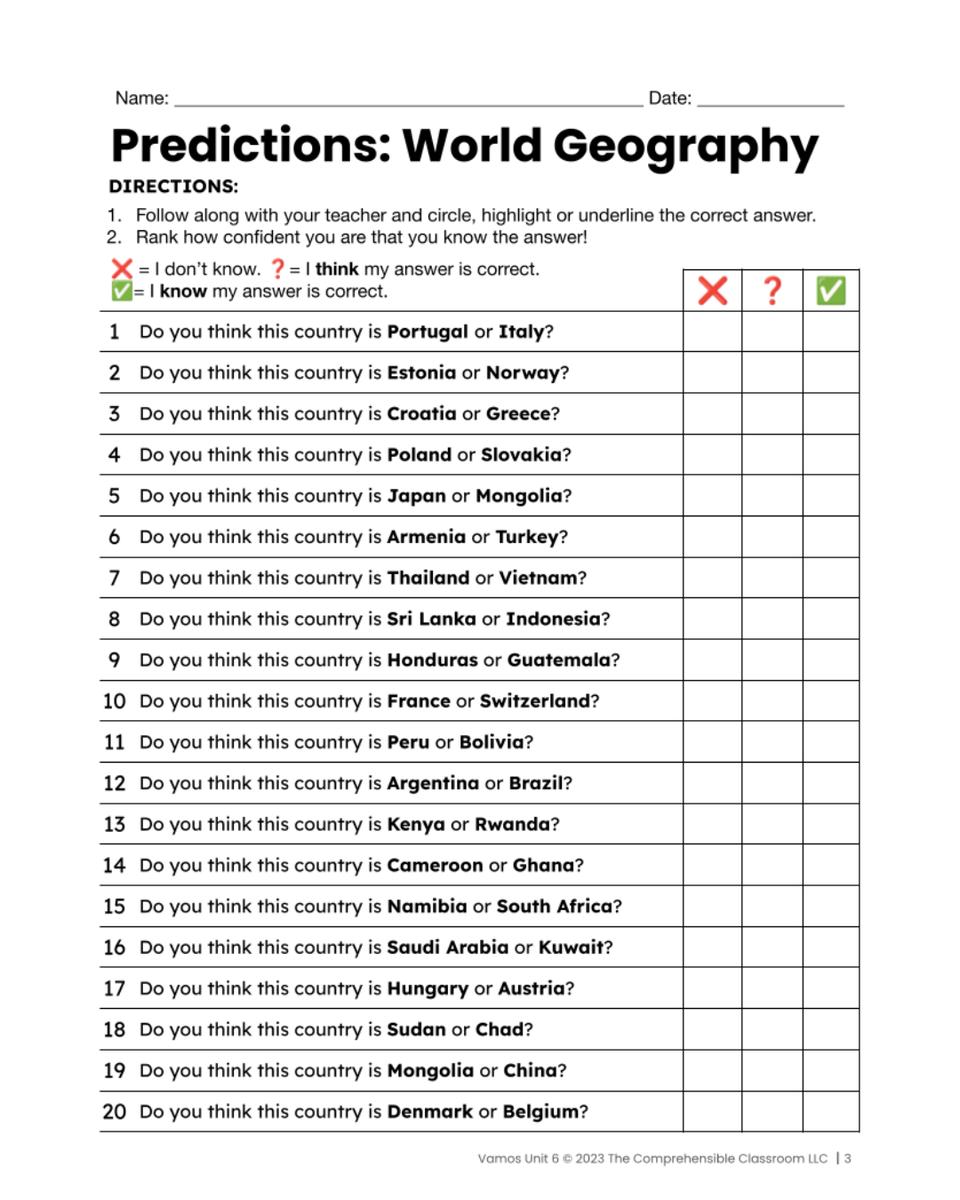
Step 2: Make predictions and wagers
In class, ask the questions to your students. You can do this in one of two ways:
- Give them a list of all of the questions at once and give them time to review them on their own, or
- Go question by question in a whole-class setting.
For each question, students not only write down an answer. They also need to mark how confident they are in the answer! They need to consider whether
- they definitely know the answer,
- think they know the answer, or
- don’t know the answer.
They’ll end up receiving a score based on how many answers they get right and wrong… but here’s the catch! Their responses will have different values based on their confidence.
If they mark an answer as “Definitely know,” it’s worth 20 points. If they get it right, they earn 20 points! But if they get it wrong… they lose 20 points.
If they mark an answer as “I think it is…”, it’s worth 10 points. Smaller risk, but smaller reward. 10 points if it’s right, minus 10 if it’s wrong!
If they mark an answer as, “I don’t know,” it’s worth 0 points. Zero risk, but zero reward.
Playing in a whole-class setting
Here’s how to play in a whole-class setting with slides. In this case, the slides are from an upcoming product for teaching English to Multilingual Learners from Comprehensible Classroom, and all the questions are about geography. We prepared slides for all of the questions, but if you’re doing this game with different content for your classes, you might not have planning time to create slides! Don’t worry–you can ask the questions orally without slides, too.
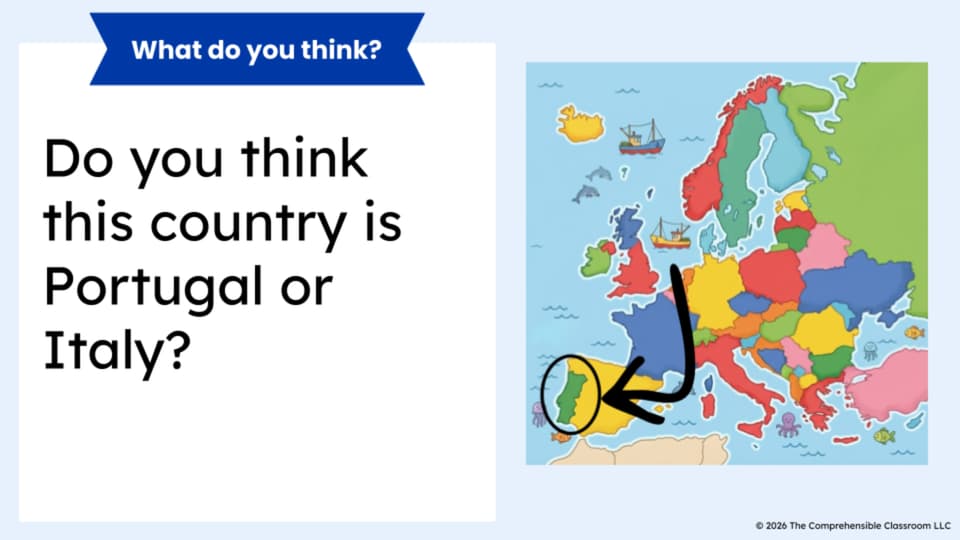
You’ll also notice that the question on this slide is an either/or question. Either/or and multiple choice questions will be easier for more students to get right, which could reduce the competitiveness of the game. However, it will also help more students to feel confident and actually take a risk, instead of just responding, “I don’t know” to many questions. Choose whether to write open-ended or either/or questions based on the dynamic of your group of students and on their language skills!
Okay–all that to say, display the slide and ask the question. Then, give students an opportunity to respond to the question on their paper. If you are not using a premade worksheet like the one we showed above, have students number the paper, write down the answer to each question, and write down their confidence rating with symbols. Write the symbols on the board for students to use on their papers:
- ❌ = I don’t know.
- ❓= I think my answer is correct.
- ✅= I know my answer is correct.
DISCUSS WAGERS: There are a few different ways you can lead this discussion, and it will depend in part on the materials you’re using (premade slides and worksheets or not). Our Curriculum Development Manager Meghan Loveless usually takes a quick poll of students in the classroom. She displays a question (and/or reads it aloud) and asks students to raise their hands for each confidence level: Who KNOWS the answer? Who THINKS they know the answer? Who DOESN’T KNOW the answer? Talk about the patterns you see, and ask follow up questions based on student personality and proficiency. For example, you might say, “12 students know the answer. That’s half the class! Half the class knows the answer. Okay, Sheena, you know the answer. What is it? Zayn, you also know the answer. Do you agree with Sheena or do you know a different answer? =Craig, you say you know the answer, but do you really know it, or do you just want 20 points? How do you know the answer?” etc.
It is very important to find opportunities, whenever you can, to affirm to students that they are not expected to know the answers and it is okay to not know information. This is a learning activity!
REVEAL THE ANSWER: After you’ve discussed students’ responses, reveal the correct answer. If you’re using a game from us, we will have provided answer slides that look like this:
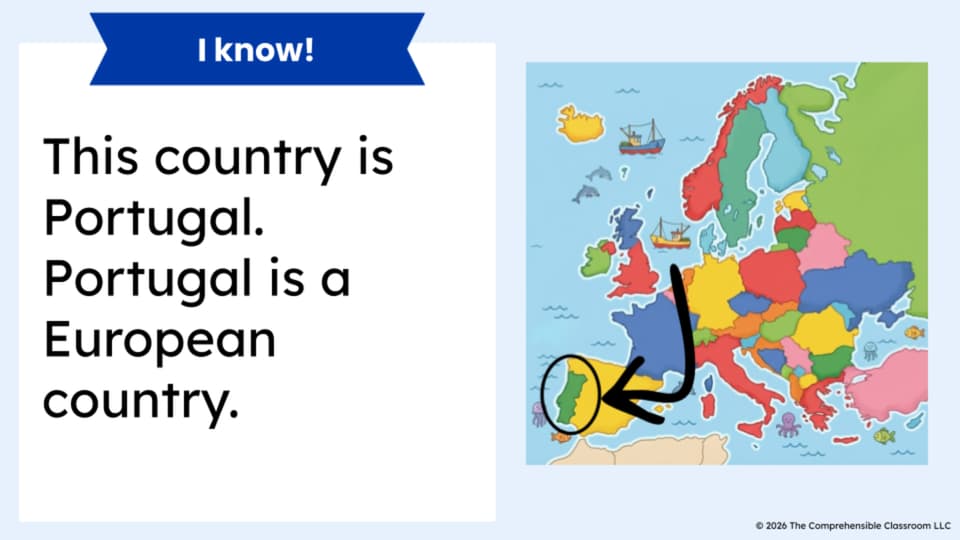
If you’re playing on your own, you might not have slides–no problem! You can say the answer out loud. Once again, keep in mind that the goal is creating communication with your students, not just covering the facts. Discuss the correct answer and share additional information that students can understand!
You’ll find that you will naturally use different tenses and moods as you discuss responses. Students will hear present tense (Do you know the answer?) and past tenses (Amanda thought that she knew…) and probably even some subjunctive, if that’s a thing in your target language. Don’t be afraid to use these mixed tenses and moods naturally, even if your students haven’t studied them. They’ll be able to understand them with your support!
CALCULATE POINTS: With the correct answer revealed, find out how many points each student won (or lost!) for their wager. Remember, students earn points for correct answers and lose points for incorrect answers.
- I know = +20/-20
- I think I know = +10/-10
- I don’t know = 0/0
At the end of the game, tally points and celebrate everyone, not just the winner!
Formatting twists
Think or Know? can be played with PearDeck® instead of with a worksheet. Students follow along and wager in PearDeck® instead of their paper.
Or, get students up and moving with a Gallery Walk or Three Corners activity!
- Gallery Walk: Display each question on a poster on the wall and students move from poster to poster reading the questions and marking their responses on a tracking sheet.
- Three corners: Label areas of the room as “Know” “Think” and “Don’t know”. As you ask each question to the whole class, students move to the zone that matches their confidence.
Confidence and Communication
Keep these two keywords in mind: CONFIDENCE and COMMUNICATION. This activity is intended to build student confidence by giving them exposure to language and content that builds background knowledge. If students are becoming discouraged and withdrawing and not feeling smart, you’ve got to change something! And, if you’re moving through the activity at lighting speed without engaging in communication with your students, you’re missing the point. Build confidence, and communicate!
We don’t just think we know you’ll love this, we know you will!
____________
Did this post resonate with you? Review our Content Use Policy for guidelines on sharing, adapting, and distributing our content.