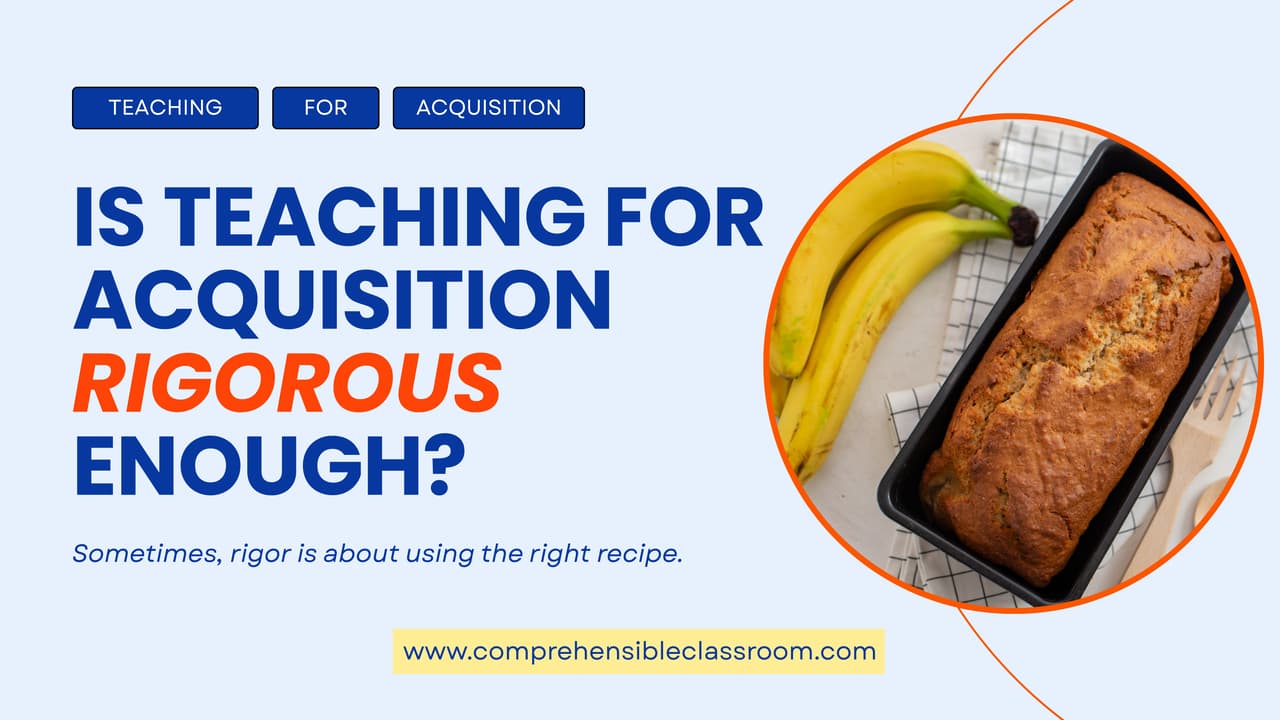
Have you ever been told that what you’re doing isn’t rigorous enough?
Let’s be honest: teaching adolescents is already plenty rigorous.
Our students are navigating complex social dynamics, growing bodies, changing emotions, and—oh yeah—social media. Adolescence itself is demanding, before we even add the challenge of learning another language.
But let’s talk about classroom rigor for a moment, because this one comes up a lot. Teachers who have committed to teaching for acquisition often hear that their classes “aren’t rigorous.”
When I hear that, I’ve learned to take a deep breath and redirect my initial flash of frustration. Because what that statement really tells me is that the person saying it doesn’t yet understand what language is—or how it develops.
And that’s good news… because that means we can help.

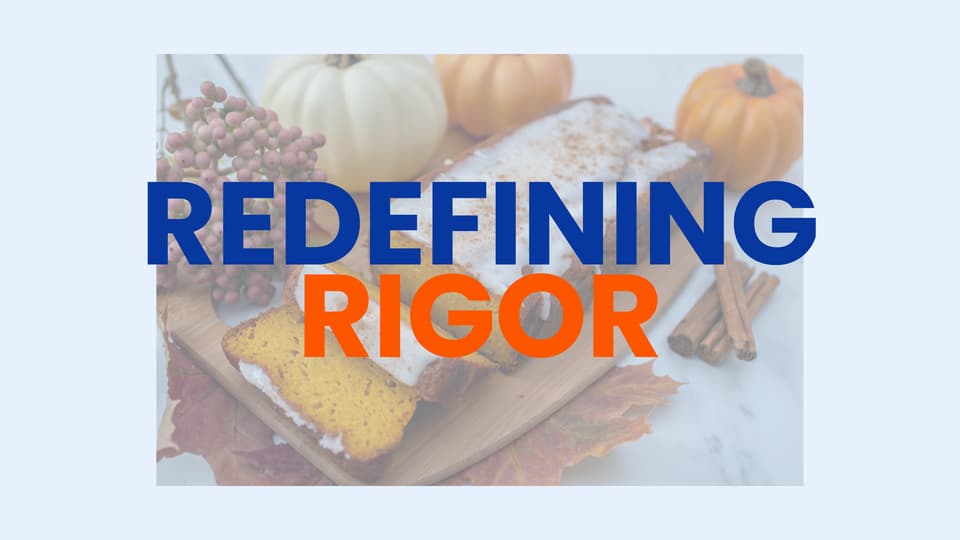
The Pumpkin Bread Problem
Imagine this: you and I agree to bring Pumpkin Bread to Thanksgiving dinner.
You pull out your family’s tried-and-true recipe. You gather the ingredients, follow the steps, taste the batter… and it’s perfect! You bake it, show up to dinner, and it’s a hit. Easy peasy.
I do the same… or so I think. I follow my mom’s recipe, but the batter tastes off—it’s more like bananas than pumpkin. I try again. And again. Still banana.
Finally, I call my mom. She laughs and says,
“Martina, that’s not my Pumpkin Bread recipe—that’s my Banana Bread recipe!”
All along, I was using the wrong recipe.

The Wrong Recipe
Making Pumpkin Bread isn’t hard when you have the right recipe, ingredients, and tools. But if you’re following the wrong recipe, it doesn’t matter how much harder you work: it won’t come out right.
That’s exactly what happens in many traditional language programs. The word rigorous is often used—incorrectly!!—as a synonym for difficult. And yes, those programs do feel difficult. Students and teachers are working hard memorizing rules, filling out charts, practicing conjugations; but none of that effort produces language proficiency.
These classes feel “rigorous” because they’re hard. But difficulty doesn’t equal rigor. True rigor leads to growth. If the hard work isn’t moving learners closer to genuine communication, then it’s not rigor; it’s just struggle.
They’re trying to make Pumpkin Bread with a Banana Bread recipe.
Explicit instruction builds knowledge about a language, not the ability to use it. The only process that actually builds language is engaging with meaningful, communicative, comprehensible input. (Read this blog post to learn what explicit instruction DOES accomplish!)
Teaching language as content might feel busy and demanding, but it’s the educational equivalent of running on a hamster wheel. The motion feels intense, but there’s no forward movement. Spinning your wheels isn’t rigor! It’s exhaustion without progress.
Redefining Rigor
So, is teaching for acquisition rigorous? Absolutely. But it’s a different kind of rigor.
If you’re used to the hamster wheel, genuine progress can feel suspiciously easy. “Wait—you mean I made perfect Pumpkin Bread on my first try?”
Fluency isn’t about how much we struggle; it’s about how effectively we align our methods with how the brain actually acquires language.
Think about your students for a moment:
- How long can they sustain focus when reading or listening?
- How often are they asked to genuinely connect with someone whose life or perspective differs from their own?
- How accustomed are they to expressing meaningful ideas about themselves, others, or the world… in another language?
That is rigor.
It’s rigorous to communicate meaningfully in a language you’re still building.
It’s rigorous to listen, interpret, and respond in real time.
It’s rigorous to open yourself to connection and understanding across cultures!
Learning in an acquisition-focused classroom is rigorous.

Real Rigor, Real Results
Teaching for acquisition doesn’t remove rigor; it redefines it. It’s not about doing more or less; it’s about doing what works. When students engage in sustained, meaningful communication in the target language, their brains are doing incredibly complex cognitive work. They’re developing a system that allows them to think, understand, and create in another language.
It’s not “less rigorous;” it’s teaching with the right recipe— and it works.
Keep Learning
Want to dive deeper into how language is acquired and what makes instruction truly rigorous?
Explore our free teacher resources or join us in an upcoming Professional Learning Experience to experience acquisition-driven instruction firsthand.
____________
Did this post resonate with you? Review our Content Use Policy for guidelines on sharing, adapting, and distributing our content.