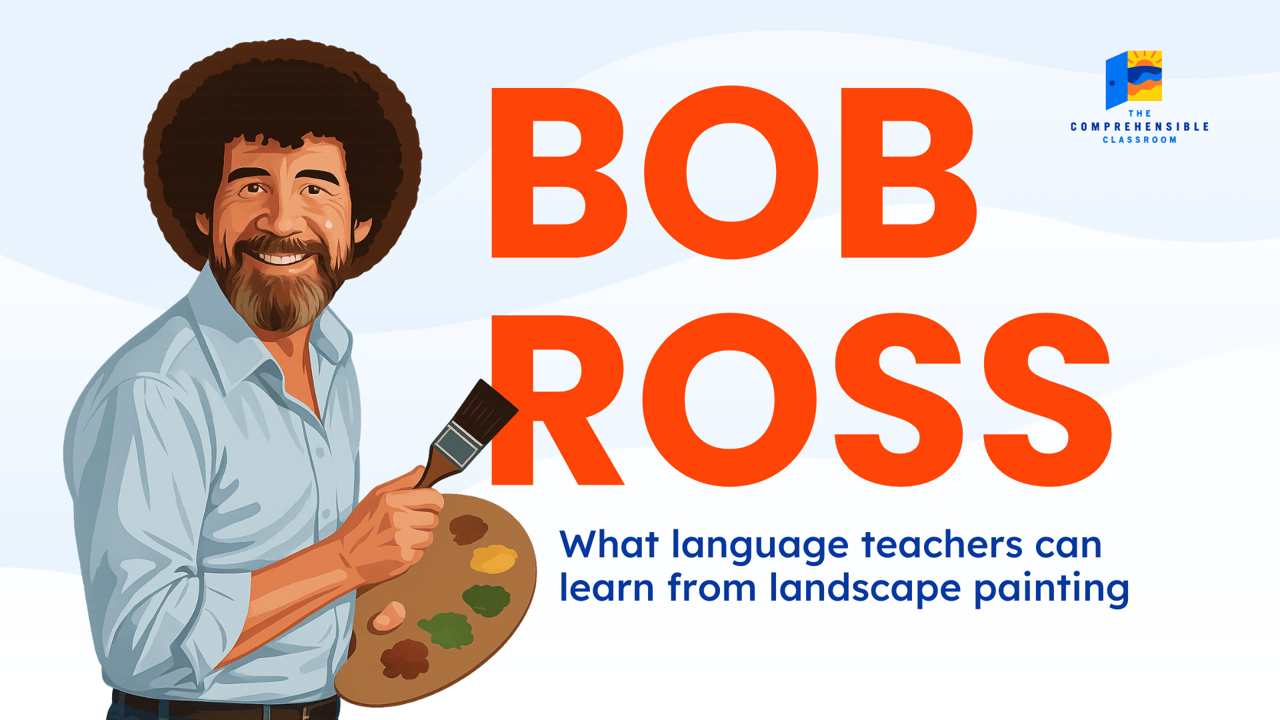
Bob Ross is a cultural icon in the United States. An American painter and art instructor, he is best known as the host of the Public Television show The Joy of Painting, which aired in the 80s and 90s and is still rerunning today. In each 30 minute episode, Bob Ross with his signature perm teaches his audience how to paint a landscape, step by step.
Now if you’ve ever watched his show, you know that the magic doesn’t happen all at once. Bob Ross always starts his painting with what looks like a smudge of color, just a few streaks or brushstrokes on the canvas. The painting never looks like a landscape out of the gate; obviously, it couldn’t! And honestly even if you paused the episode ten minutes in, you might still think that it doesn’t look like anything at all.
That’s because the painting isn’t finished. And I want to explain to you two ways in which language acquisition is like Bob Ross.
Take it in and reconstruct it
First of all, Bob Ross teaches landscape painting. And what a landscape painter does is take in the real world with their vision and then paint a version of what they are seeing on canvas. Just like the painter captures a real world landscape and rebuilds it on paper, our brains capture real world language and rebuild it in our heads. The painting begins with a blank canvas and then a few broad strokes. The painter continues to study or take in the landscape and add more strokes to the canvas.
As a skilled painter spends more and more time working on a painting, they add new elements and subtle details that make the painting look ever more similar to the real-world landscape they’re trying to capture.
Language acquisition works the same way. Our linguistic system begins as a blank slate. As we first take in a new language, our brains begin to build simple pieces into our linguistic system. These pieces might be just a few key words or phrases, and they are the first brushstrokes on a blank canvas. Over time as we take in more and more language, the system of language in our heads becomes more and more intricate, and ever more like the language being used in the world around us. In painting and in language, the masterpiece doesn’t appear all at once. It starts with the basics, and every new detail we take in brings us closer to the real thing. Language acquisition takes time and exposure.
It happens in layers (stages)
The second way in which language acquisition is like Bob Ross is that it happens in layers. Bob Ross doesn’t paint from left to right or top to bottom on a canvas. He doesn’t perfect one side of the canvas and then perfect the next section, and so on and so forth. He paints in layers. The first layer of a Bob Ross painting, with just some smudges and streaks of colors, isn’t a bad painting or a wrong painting. It’s a base layer. Traditional textbooks approach language teaching with a left-to-right approach. Master one thing, then move on to the next. But that’s not how language acquisition works. It works like landscape painting, which happens in layers.
Just like crawling isn’t bad walking, an unfinished painting isn’t a bad painting. A smudgy, plain painting toward the beginning of an episode is exactly what it should be. And smudgy, plain language at Novice levels of proficiency is exactly what it should be. Bob Ross surprises viewers with Happy Little Trees when the painting is almost finished, and your learners will start surprising you with their accurate control of language when they reach Advanced stages of proficiency.
When we allow students to progress through the stages of acquisition naturally -- by engaging them with meaningful input, embedded in communication, that they understand -- complex, accurate language will emerge, but it’s going to take time and it’s not going to be linear. You can trust Bob Ross to always finish the episode with a complete, complex, and beautiful painting, and even though your students aren’t going to do it in 30 minutes, you can trust that when you focus your teaching on language acquisition, those Happy Little Trees will show up. Just keep painting!
--------------------------
If the ideas in this post resonate with you, you are welcome to share this metaphor with credit to Martina Bex from The Comprehensible Classroom, along with a link to the blog post or video. Learn more about giving credit here. Review our Content Use Policy for guidelines on sharing, adapting, and distributing our content.