Imagine planting a seed, watering it faithfully, tending the soil, and watching… and nothing. You wait some more. You water some more. You show up every day. You’re a Gardener, after all! You care for those little seeds that you so carefully placed beneath the soil. And you wait. Days pass. Weeks pass. Months pass. And still, you see nothing.
But just because you see nothing doesn’t mean nothing is happening.
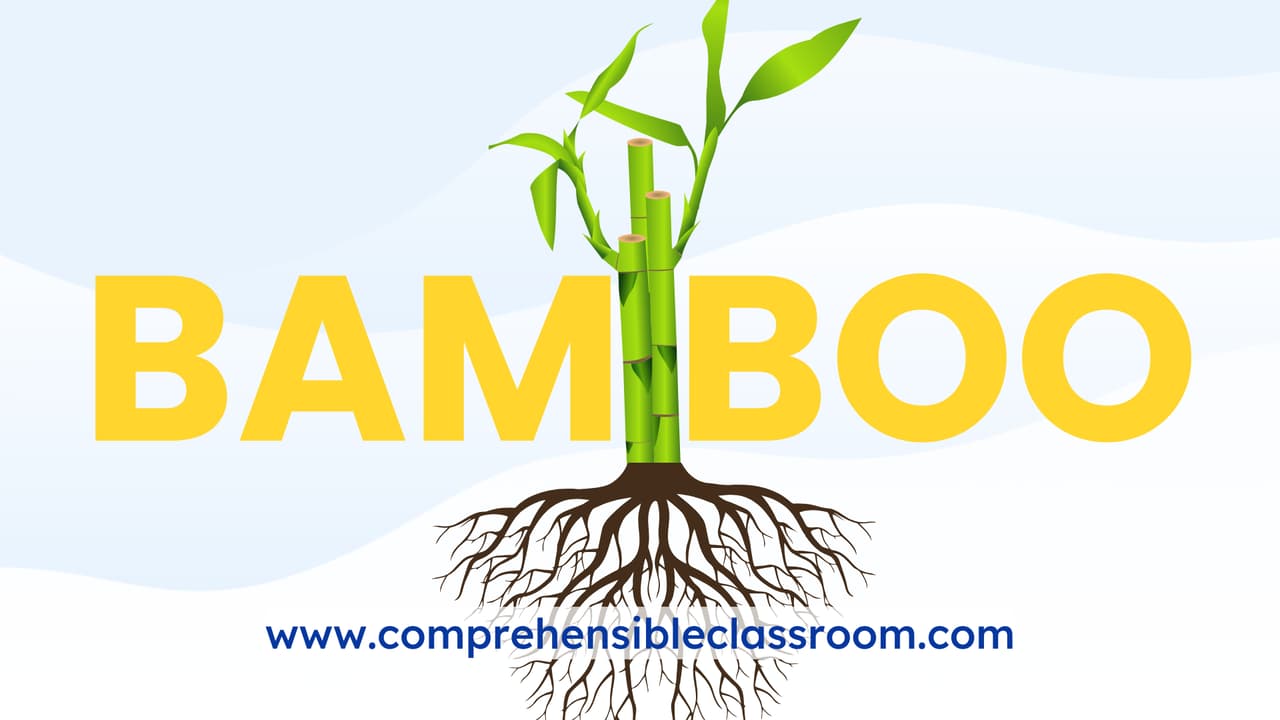
Here’s a fun fact: when you plant bamboo, nothing breaks the surface for the first few years. Not a single green shoot. For up to four years, bamboo grows downward, not upward. It sends out roots. It anchors itself. It builds a network underground, quietly and invisibly, without any evidence on the surface. And then, all of a sudden, BOOM! It can grow up to three feet in a single day.
Here’s why I’m sharing this: Language acquisition works like that.
When students are in the early stages of acquiring language (especially in their first weeks or months with the language) they may not speak much or even at all. It may seem like nothing is happening because getting them to speak is like pulling teeth! But just like bamboo, what we can see in terms of their language production isn’t the full story. Language is taking root under the surface even when it’s not visible above the surface.
A few years ago I heard Dr. Karen Lichtman tell a story about her 21-month-old daughter that captures this perfectly. Up until 20 months, her daughter added new words to her oral vocabulary very slowly. Dr. Lichtman was worried. Why wasn’t she saying more? Why wasn’t there more “progress”? And then, bam! Between 20 and 21 months, her daughter’s speech exploded. In that month, she introduced so many new words into her vocabulary. She said so many new words for the first time!
But here’s the thing: she didn’t learn all those words in that one month. She didn’t suddenly acquire this massive quantity of vocabulary overnight. Those words had been there, inside her head, quietly building up over time. What happened between 20 and 21 months wasn’t a sudden burst of language growth. It was a sudden burst of growth in spoken communication.
And that distinction matters. Language is used to communicate, and it can be observed through communication, but language and communication are not the same thing. Dr. Lichtman’s daughter had been acquiring language long before she started using it to speak. But it wasn’t visible. Her brain was busy growing roots as it made sense of the language being used around her. It was busy forming connections and creating a complex internal linguistic system.
This happens with our students too. It doesn’t matter that they already are able to form words with their mouths and vocal cords. It doesn’t matter that they are already fluent in at least one language. It doesn’t matter that they are teenagers, not babies. They still need time for language to build up inside their heads before they are ready to speak. They will still pass through what is called a Silent Period.
Now you might be thinking, “Bollocks! My students are already talking on Day 1 of Level 1”. Hey–mine are producing sounds too, so I get it. But not all speaking is true output. Much of speaking is repetition, memorized, and coming out of the declarative memory system. If you watched my other metaphor, you’ll understand me when I say they’re using the stuff in the Attic. True output, which is characterized by meaning-making, comes out of a linguistic system. And that linguistic system has to be formed before anything can come out of it. And as that system is putting down its initial roots, students are going to live in the Silent Period.
During the Silent Period, they are storing up language, not as isolated words or memorized rules, but as connected meaning. They’re building the system that will one day allow them to speak fluently and confidently, even if it’s initially just in simple utterances. The Silent Period is going to look different for every student, and that’s why we advocate for holding off on speaking assessments until all students have had a chance to build up enough internal language to be able to truly speak. To truly make meaning as they communicate, not just parrot words back at you.
Oral proficiency doesn’t develop from practicing speaking. It comes from engaging with communicatively-embedded comprehensible input. Language students can understand, delivered in meaningful communicative contexts, over time.
So when your students are quiet… trust the roots. When they hesitate or stay silent but show you with their eyes and their reactions that they’re not stuck, they’re growing. And when they’re ready?
Like bamboo, they’ll shoot up seemingly overnight. The messages will come. The spoken communication will catch up to the language that’s already been quietly growing inside.
You are a gardener, so keep watering the soil. The most important growth doesn’t happen on the surface. It happens underground. Let it!
--------------------------
If the ideas in this post resonate with you, you are welcome to share this metaphor with credit to Martina Bex from The Comprehensible Classroom, along with a link to the blog post or video. Learn more about giving credit here. Review our Content Use Policy for guidelines on sharing, adapting, and distributing our content.